The curtain lifts on the World Cup, Italy’s road to PyeongChang 2018 starts in Sölden
- ALPINE SKIING
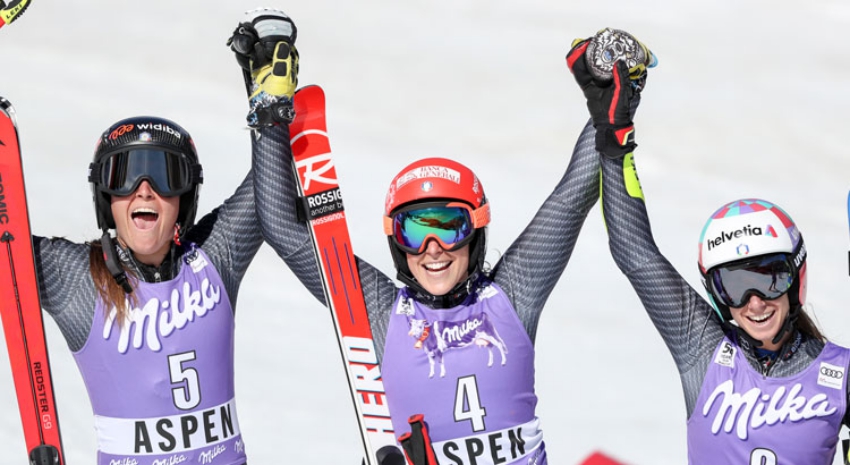 The curtain lifts on the Alpine Skiing World Cup as Italy’s road to the PyeongChang 2018 Winter Olympics begins in Sölden.
The first on the Rettenbach glacier will be the Italian athletes in the Women's Giant Slalom tomorrow. Sunday will see the men take on the Austrian slopes.
Eight athletes were invited by head coach Matteo Guadagnini for the start of a season following an all-Italian podium in the ASPEN Finals: Marta Bassino, Luisa Bertani, Elena Curtoni, Irene Curtoni, Jole Galli, Sofia Goggia, Manuela Moelgg and Laura Pirovano. A long list of absentees stands out, including Federica Brignone, Francesca Marsaglia and Nadia Fanchini, all three recovering after a series of injuries and not yet ready to give it their all in a competition as challenging as the one in Austria. In recent days, Brignone has started skiing again for the first time since her return from Argentina. Though the bone oedema to her adductor muscle is on the mend, in agreement with technical staff, she preferred not to take any risks. She will return on top form at the next American giant slalom in Killington on Saturday 25 November.
Previous years in Sölden have seen two Italian victories: Denise Karbon in 2007 (who also came third in 2009) and Brignone in 2015, in addition to Manuela Moelgg's third place in 2010 (holder of most appearances on the Rettenbach) and Deborah Compagnoni’s second and third place positions in 1996 and 1998.
The men’s team has also been decided by sports director Massimo Rinaldi: Giovanni Borsotti, Luca De Aliprandini, Florian Eisath, Simon Maurberger, Manfred Moelgg, Roberto Nani, Dominik Paris and Riccardo Tonetti. In the previous 18 tournaments, Italy has conquered two podiums with Max Blardone’s second place in 2004 and Manfred Moelgg’s second place in 2012. Moelgg will race at Sölden for the 12th time in his career.
Italy will also be the protagonist from an organisational perspective, with the ten Cup stages awarded to our ski resorts. After the debut this weekend, the team will take a week’s break and start again from Finland before travelling to America. They return to Europe on 8 December where the women will take on St. Moritz and the men Val d’Isère.
Olympic Channel celebrates Fontana: "Arianna still got the fire!"
- FLAGBEARER
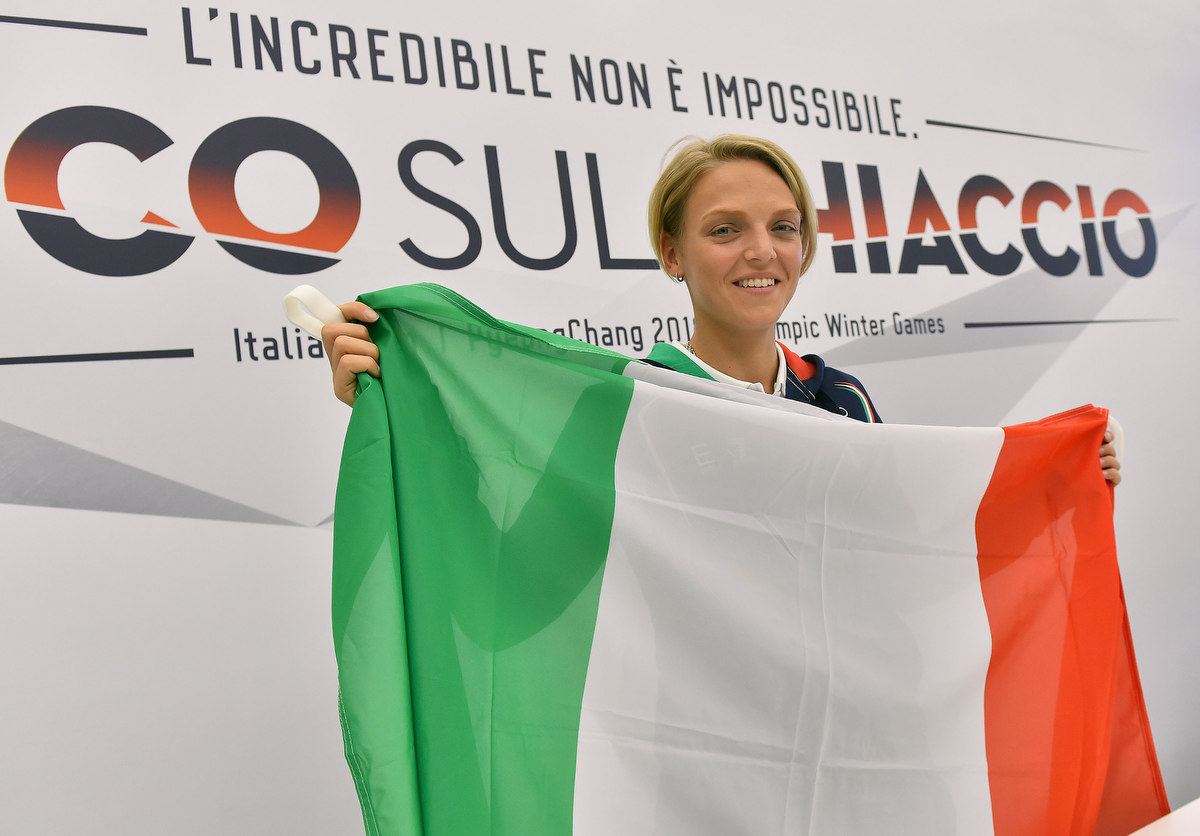 The Olympic Channel celebrated the Italian flagbearer to PyeongChang in 2018, Arianna Fontana, with an interview recorded yesterday in the Sala delle Fiaccole, at the Foro Italico, right after the selection of the Italian athlete formally announced by the President of CONI, Giovanni Malagò, to the members of the National Commission.
“Arianna still got the fire!”, wrote the Olympic Channel about the short track champion, the youngest Italian to win a medal (aged 15 years and 10 months) at the Winter Olympic Games who won medals in three consecutive Olympic Games, winning the bronze medal in Vancouver in 2010 in the 500 metres, and was three times a champion in Sochi in 2014, with a silver medal for the 500 metres, and bronze medals in the 1500 metres and the relay (photos by Mezzelani-GMT).
National Council Statement
- CONI
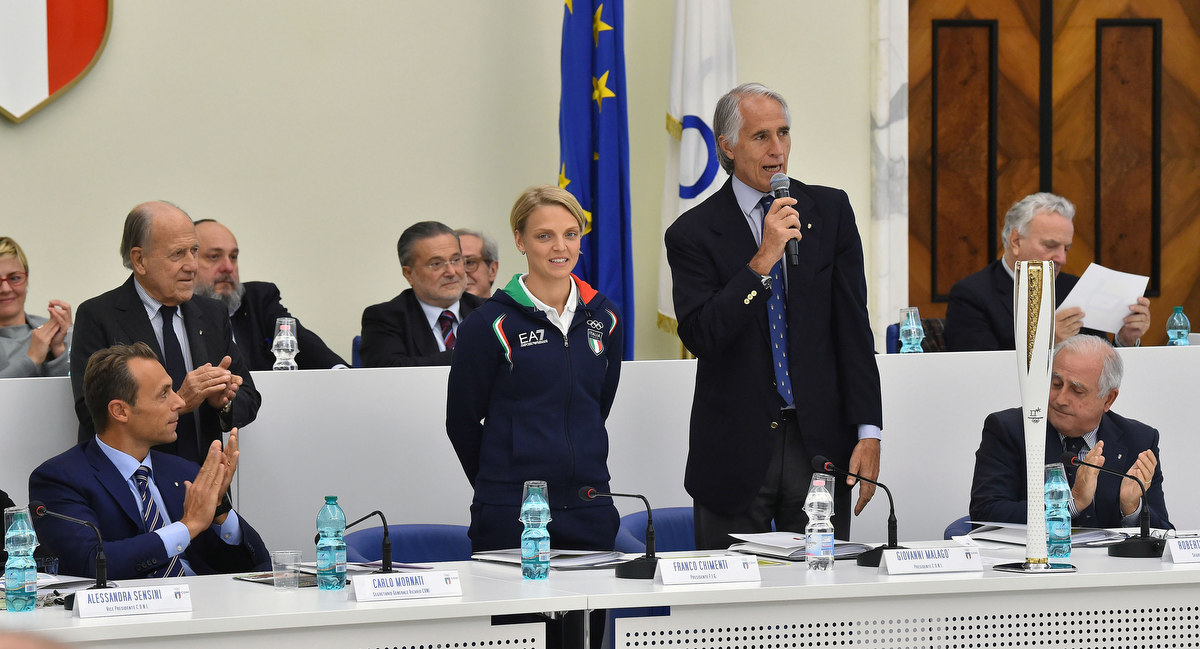 The 255th National Council of CONI met this afternoon at 16.00 in the Salone d’Onore of Foro Italico to discuss the following Agenda:
1) Approval of the minutes of the meeting on 18 July 2017: minutes unanimously approved.
2) Communications by the President: the meeting started with homage to Arianna Fontana, standard bearer to PyeongChang in 2018. The President then expressed pride in the modernisation of the Salone d’Onore. Italy - in 2017, to date - has won 35 medals in the World Championship for Olympic disciplines, achieving satisfactory results also for the results obtained by non-Olympic Federations.
Mr Malagò also expressed the satisfaction of the world of sport for the election of Tania Cagnotto to the Athletes Commission of the EOC and then welcomed the election of Luciano Buonfiglio, President of Federcanoa, and Francesco Soro, Shooting Commissaire, to the Council. The situation at AeroClub was also brought to the attention of the Council. The President, with regard to the mandate law progress, stated that the process was approaching its end. He reported to the Council with regard to the CIO’s session work in Lima, with the dual assignment of the 2024 and 2028 Olympics and the attribution of the 2019 session to Milan.
He reminded the meeting of “Stati Generali” on the 20th and 21st November, with the attendance of the CIO’s general director, Mr Christophe De Kepper, and many other important personalities. Mr Malagò reminded the meeting that, during his presidency, there have been no inclusions of new situations in the pre-existing status, an element of credibility with regard to institutional interlocutors.
The President reminded the meeting of the significant efforts in view of PyeongChang in 2018 with the aim of improving on Sochi’s results, thanks to the commitment of FISI and FISG. Mr Malagò spoke about the 2019 Universiade in Naples, stressing that efforts need to be improved to achieve an event up to expectations. With regard to procedures, the positive comments by Mr Cantone, ANAC’s President, during the Sport Governance Conference regarding CONI as a reference and guarantee model were conveyed to the meeting.
The following intervened with regard to the President’s report: Giovanni Petrucci (Basketball), Bruno Cattaneo (Volleyball), Domenico Falcone (Judo, Wrestling, Martial Arts), Franco Chimenti (Golf), Carlo Tavecchio (Football), Ugo Matteoli (Competitive Fishing and Sub-Aqua Sports), Mario Pescante (CIO), Ugo Salines (EPS), Vincenzo Manco (EPS)
3) F.S.N .- D.S.A. - E.P.S activities.: the following resolutions were unanimously approved: 1) annual entry cap on foreign athletes not belonging to the European Community equivalent to 1149 for 2017/2018 with assignment of entries and definition of general assignment and registration criteria. 2) appointment of members of the “Collegio di Garanzia dello Sport”, Saverio Capolupo and Angelo Canale.
4) CONI Administrative Affairs and Accounts: ratification of the first rescheduling of the 2017 Budget. In the context of this approval - on occasion of which, among other things, greater resources were assigned to National Sport Federations for PO/AL programmes -, the National Council, again on proposal by the Commission, has approved the CONI budget for the 2018 financial year which presents a break-even result. The contributions assigned by the state for 2018 are substantially in line with those for 2017 (416.8 millions, inclusive of finalised contributions of 10.4 millions for the organisation in Italy of some international Federation sports). The Budget, compared to that for the previous financial year, considering the need to adequately support institutional projects in 2018 such as the 2018 PyeongChang Games, the organisation of the 2019 CIO session, some projects in the School sector, includes residual resources slightly lower than those in the previous year. The contributions to National Sports Federations are in line with those in 2017 for all their internal administrative organisations, including the part of the model of contributions, with the exception of the supplementary ones for PO/AL, which are lower than indicated above. The contributions recognised to other supported organisations (DSA; EPS; FF.AA.; AB, etc) are in line with historical data, and the payment for the service contract with Coni Servizi SpA is in line with the value of the updated budget for the 2017 financial year. The Budget further highlights a greater volume of activity for a series of projects fully funded by third parties, such as “Sport e Periferie” and “La Nuova Stagione” projects. As there was no other business, the meeting came to an end at 17.50.
National Council Statement
- CONI
The 255th National Council of CONI met this afternoon at 16.00 in the Salone d’Onore of Foro Italico to discuss the following Agenda:
1) Approval of the minutes of the meeting on 18 July 2017: minutes unanimously approved.
2) Communications by the President: the meeting started with homage to Arianna Fontana, standard bearer to PyeongChang in 2018. The President then expressed pride in the modernisation of the Salone d’Onore. Italy - in 2017, to date - has won 35 medals in the World Championship for Olympic disciplines, achieving satisfactory results also for the results obtained by non-Olympic Federations.
Mr Malagò also expressed the satisfaction of the world of sport for the election of Tania Cagnotto to the Athletes Commission of the EOC and then welcomed the election of Luciano Buonfiglio, President of Federcanoa, and Francesco Soro, Shooting Commissaire, to the Council. The situation at AeroClub was also brought to the attention of the Council. The President, with regard to the mandate law progress, stated that the process was approaching its end. He reported to the Council with regard to the CIO’s session work in Lima, with the dual assignment of the 2024 and 2028 Olympics and the attribution of the 2019 session to Milan.
He reminded the meeting of “Stati Generali” on the 20th and 21st November, with the attendance of the CIO’s general director, Mr Christophe De Kepper, and many other important personalities. Mr Malagò reminded the meeting that, during his presidency, there have been no inclusions of new situations in the pre-existing status, an element of credibility with regard to institutional interlocutors.
The President reminded the meeting of the significant efforts in view of PyeongChang in 2018 with the aim of improving on Sochi’s results, thanks to the commitment of FISI and FISG. Mr Malagò spoke about the 2019 Universiade in Naples, stressing that efforts need to be improved to achieve an event up to expectations. With regard to procedures, the positive comments by Mr Cantone, ANAC’s President, during the Sport Governance Conference regarding CONI as a reference and guarantee model were conveyed to the meeting.
The following intervened with regard to the President’s report: Giovanni Petrucci (Basketball), Bruno Cattaneo (Volleyball), Domenico Falcone (Judo, Wrestling, Martial Arts), Franco Chimenti (Golf), Carlo Tavecchio (Football), Ugo Matteoli (Competitive Fishing and Sub-Aqua Sports), Mario Pescante (CIO), Ugo Salines (EPS), Vincenzo Manco (EPS)
3) F.S.N .- D.S.A. - E.P.S activities.: the following resolutions were unanimously approved: 1) annual entry cap on foreign athletes not belonging to the European Community equivalent to 1149 for 2017/2018 with assignment of entries and definition of general assignment and registration criteria. 2) appointment of members of the “Collegio di Garanzia dello Sport”, Saverio Capolupo and Angelo Canale.
4) CONI Administrative Affairs and Accounts: ratification of the first rescheduling of the 2017 Budget. In the context of this approval - on occasion of which, among other things, greater resources were assigned to National Sport Federations for PO/AL programmes -, the National Council, again on proposal by the Commission, has approved the CONI budget for the 2018 financial year which presents a break-even result. The contributions assigned by the state for 2018 are substantially in line with those for 2017 (416.8 millions, inclusive of finalised contributions of 10.4 millions for the organisation in Italy of some international Federation sports). The Budget, compared to that for the previous financial year, considering the need to adequately support institutional projects in 2018 such as the 2018 PyeongChang Games, the organisation of the 2019 CIO session, some projects in the School sector, includes residual resources slightly lower than those in the previous year. The contributions to National Sports Federations are in line with those in 2017 for all their internal administrative organisations, including the part of the model of contributions, with the exception of the supplementary ones for PO/AL, which are lower than indicated above. The contributions recognised to other supported organisations (DSA; EPS; FF.AA.; AB, etc) are in line with historical data, and the payment for the service contract with Coni Servizi SpA is in line with the value of the updated budget for the 2017 financial year. The Budget further highlights a greater volume of activity for a series of projects fully funded by third parties, such as “Sport e Periferie” and “La Nuova Stagione” projects. As there was no other business, the meeting came to an end at 17.50.
Arianna Fontana will be the flag bearer for Italy at PyeongChang 2018
- OLYMPIC GAMES
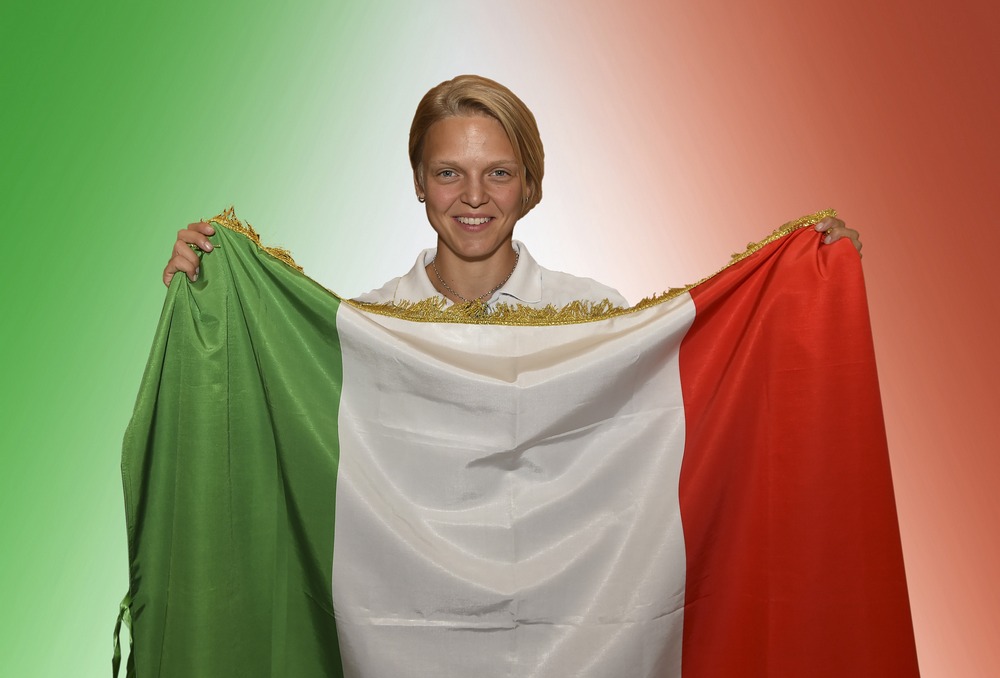 Arianna Fontana will be the flag bearer for Italy at PyeongChang 2018. The champion speed skater’s nomination was formally announced this morning by CONI President, Giovanni Malagò, to Committee members at the Foro Italico. Fontana is the first short track flag bearer in Italian history, the seventh woman ever, the second from Lombardy and the second athlete from the FISG after Carolina Kostner. She is the youngest Italian to have won a medal at the Winter Olympic Games (15 years and 10 months), thanks to the bronze won with the Italian relay team at Turin 2006. She has made it onto the podium for three consecutive editions of the Games, winning bronze at Vancouver 2010 in the 500m and finishing three times on the podium at Sochi 2014: silver in the 500m, and bronze in the 1500m and the relay.
Olympic flame for PyeongChang 2018 lit in Greece
- OLYMPIC FLAME-LIGHTING CEREMONY
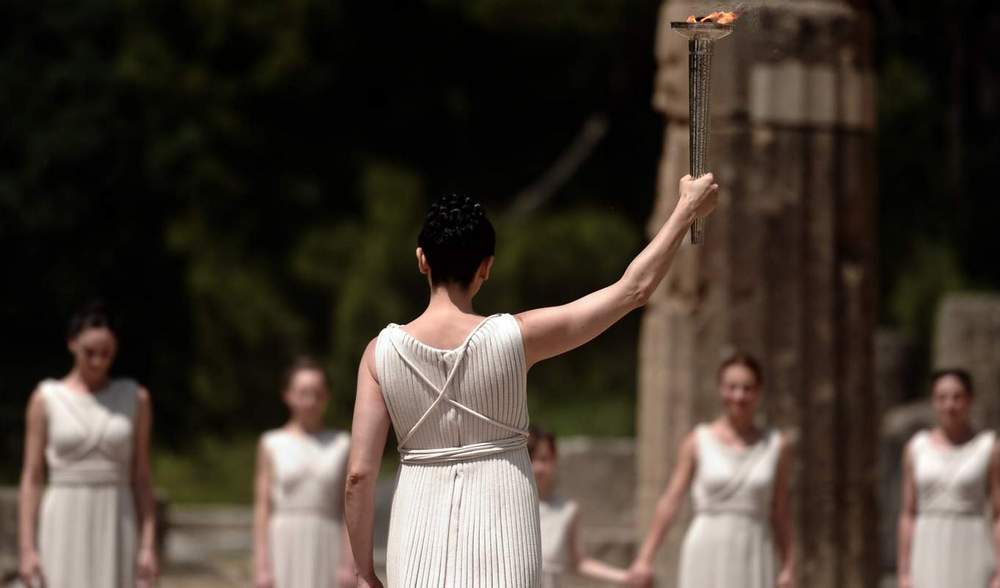 The Olympic Torch Relay starts the final countdown to one of the greatest athletic and cultural events in the world. Taking place as it does against the backdrop of Olympia, the Olympic flame-lighting ceremony serves more than any other tradition to connect the modern Games with their ancient origins and – like the messengers who proclaimed the sacred Olympic truce – the runners who carry the Olympic flame will carry the message of the Olympic values on their journey.
As a symbol of the good that the Olympic Games can do to bring the world together, the President of the International Olympic Committee (IOC), Thomas Bach, alongside a number of National Olympic Committee (NOC) leaders, took part in the ceremony to show their support for the Games, which will begin on 9 February next year.
Representatives of the NOCs of the upcoming Olympic Games and Olympic Winter Games included: Tsunekazu Takeda (JPN), Zaiqing Yu (CHN), Denis Masseglia (FRA) and Lawrence F. Probst III (USA). They joined the President of the PyeongChang 2018 Organising Committee (POCOG), Lee Hee-beom and the President of the NOC of the Republic of Korea Kee-Heung Lee, as well as Spyros Capralos from the Hellenic Olympic Committee (GRE).
“As our founder, Pierre de Coubertin, once said: ‘The Olympic Games are a pilgrimage to the past and an act of faith in the future,’” President Bach told the crowd at the ceremony.
He continued: “What better expression of this faith in the future, than the presence of the President of the Hellenic Olympic Committee, together with the Presidents of the National Olympic Committees of the Republic of Korea, Japan, China, France and the United States of America. Together, they represent the future hosts of Olympic Games, PyeongChang 2018, Tokyo 2020, Beijing 2022, Paris 2024 and Los Angeles 2028. Today’s ceremony marks the beginning of the celebration of the Olympic Winter Games PyeongChang 2018.”
The PyeongChang 2018 Olympic Torch Relay is an invitation to join in the celebrations around the Olympic Winter Games PyeongChang 2018 and be inspired by its message: “Passion. Connected.”
The IOC President was joined by the Chair of the PyeongChang 2018 Coordination Commission and IOC Executive Board Member Gunilla Lindberg and a number of other IOC members.
“I am very proud to be here today in Ancient Olympia to see the Olympic flame begin its journey to PyeongChang in the Republic of Korea,” said Lee Hee-beom, President of POCOG.
He continued: “The start of the Olympic Torch Relay today is one of the most important milestones in our journey to February 9th. The Olympic Torch Relay will be a celebration of the passion that our nation has for the Olympic Movement as we welcome the flame back to our shores for the first time since the Seoul Olympic Games of 1988. Korea is ready to welcome the world again in PyeongChang.”
Also present at the ceremony was Greek President Prokopis Pavlopoulos.
"Today's ceremony and the Olympic Games send a very important message to the world, " he said. "Under the leadership of President Bach, the Olympic Movement continues to play a unique role in the world."
Twenty-four-year-old cross-country skier Apostolos Angelis from Greece, who has already secured his participation in PyeongChang 2018, was the first torchbearer. He passed on the flame to famous football player Park Ji-Sung from the Republic of Korea.
Over the following week, the flame will travel around Greece. It will cover 2,129km on Greek territory and will arrive at the Acropolis on 30 October. Some 505 torchbearers will participate, and 36 welcome ceremonies will be held in 20 municipalities over the eight days. The ceremony to hand over the flame to the PyeongChang 2018 Organising Committee will be held at the Panathenaic Stadium on 31 October.
Then the flame will make its way 8,500km east, to the Korean city of Incheon, arriving on 1 November to coincide with 100 days to go until the start of the Olympic Winter Games PyeongChang 2018.
Thereafter, the Olympic Torch Relay will see the flame embark on a tour of the entire host country, taking in nine provinces and eight major cities, before it finally arrives at the PyeongChang Olympic Stadium in time for the Opening Ceremony on 9 February 2018.
The Olympic Winter Games PyeongChang 2018 will run from 9 to 21 February in PyeongChang, and will feature approximately 3,000 athletes from 95 NOCs.
Tania Cagnotto elected to the Athletes Committee of the European Olympic Committee
- 2017-2020
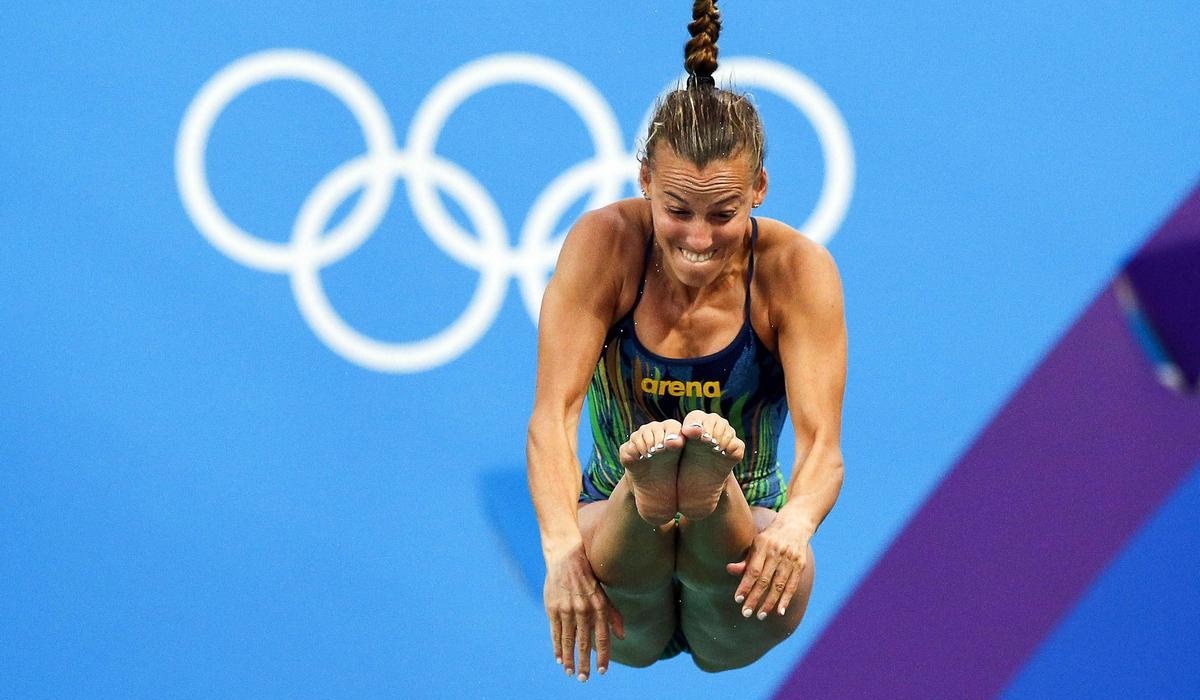 Tania Cagnotto joins the Athletes Committee of the European Olympic Committee for the 2017-2021 four-year period.
The Italian diver, silver medallist in Rio in 2017 for the 3-metres springboard with Francesca Dallapé and bronze medallist for the women 3-metres, was chosen in Monte Carlo, at the European Athletes Assembly, from among 18 candidates for the eight available places (six for summer sports and two for winter sports).
The new committee is presided by the Estonian discus thrower Gerd Kanter, with the Hungarian Balazs Baji (110 metres hurdles) as vice-president and the Irish David Harte (field hockey) as secretary. Also elected to the committee were the Latvian Gunta Latiseva-Cudare (athletics), the Turkish Nevriye Yilmaz (basketball), the Slovenian Jana Daubnerova (biathlon) and the Norwegian Eldar Ronning (cross-country skiing).
Tokyo 2020, Mornati signs Team Italy's pre-Olympic campus agreement in Tokorozawa
- AT THE EMBASSY
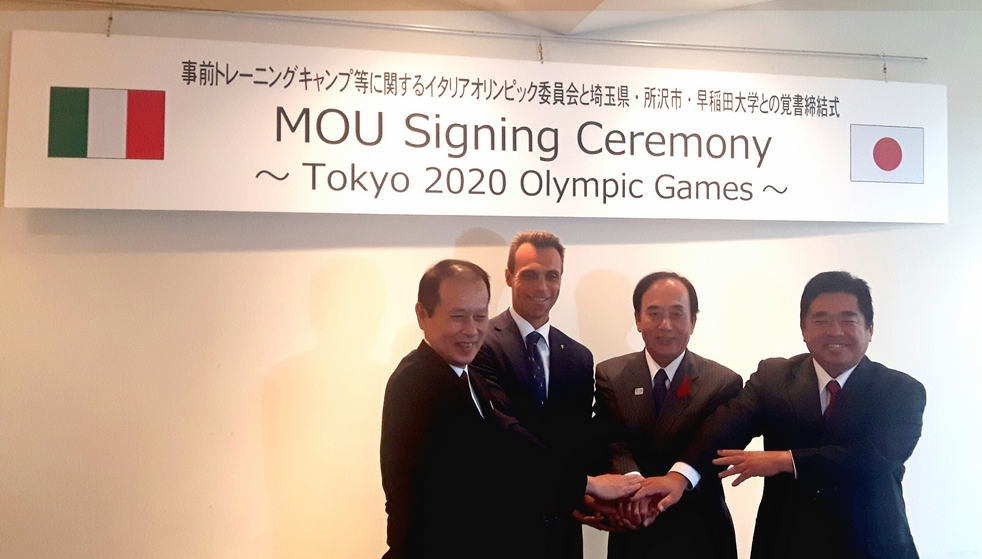 Today, at the Italian Embassy in Tokyo, CONI's Vice Secretary General and Head of Olympic Training, Carlo Mornati, signed a memorandum of understanding between the Italian National Olympic Committee, the Saitama Prefecture, the city of Tokorozawa and Waseda University for the use of a university campus to host the Italian athletes and facilitate their training before the Tokyo 2020 Olympics.
The Italian Ambassador in Tokyo, Giorgio Starace, did the honours in the presence of the Governor of Saitama, Kiyoshi Ueda, the Mayor of Tokorozawa, Masato Fujimoto, the President of Waseda University, Kamata Kaoru, the President of the Organising Committee of Tokyo 2020, Yoshiro Mori, and the Vice Presidents of the Japanese Olympic Committee, Yasuo Saito, Seiko Hashimoto and Eisuke Hiraoka.
In particular, the agreement guarantees Team Italy the benefits of the prestigious area of Tokorozawa, a location with exclusive characteristics due to the variety of buildings and uniqueness of the spaces offered, by virtue of the presence of both an athletics field and Olympic-size swimming pool, a rare and special combination situated in greater Tokyo.
The campus is also equipped with an archery facility, six grass tennis courts, a covered multi-use sports hall and a multi-functional pitch. Tokorozawa also represents a logistically optimal solution given the additional benefit of an on-campus canteen and accommodation, which will save the Italian athletes travelling time and energy during the lead-up to the Olympics.
Following intense and successful scouting activities carried out by the Sports Area and Olympic Preparation by Anna Riccardi less than 3 years before Tokyo 2020, the Italian National Olympic Committee is the third in the world to have identified a location multi-use sport that meets athletes’ needs during the Olympic Games. The operational details of the agreement signed today, the specific campus buildings to be used and the actual period of the training camps will be determined, before 2018, based on Team Italy’s specific requirements, the most comprehensive schedules of the various Federations and the developments determined by the first Olympic qualifying tournaments.
On 24 October, President Malagò will announce Team Italy’s Flag Bearer
- ROAD TO PYEONGCHANG 2018
 The Italian flag bearer at the upcoming 2018 Winter Olympics in PyeongChang will be announced by CONI President, Giovanni Malagò, in a press conference that will be held in the Italian Olympic Committee’s Salone d'Onore on Tuesday 24 October 2017 (beginning at 13:00), following the National Committee’s proceedings.
The flag bearer will be given the Italian flag by the President of the Italian Republic, Sergio Mattarella, on 18 December at the Quirinal Palace, and will lead the Italian Team in the opening ceremony on 9 February (12:00 Italian time) at the PyeongChang Olympic Stadium.
The date for the announcement of the standard bearer was not chosen at random: this year, 24 October also marks the date that the Olympic flame will be lit in Olympia. The Ceremony will be shown live on the Olympic Channel.
The torch will arrive in PyeongChang on 31 October and begin its tour of the Korean peninsula. Over 101 days, with the help of 7500 torch bearers (and 2018 back-up torch bearers), it will pass through 17 metropolitan cities and provinces, highlighting the Asian country’s technology and traditional culture.
The Olympic rings arrive at Buenos Aires to celebrate one year to go to the Youth Olympic Games
- #1YEARTOGO
 The setting up of the Olympic rings at the downtown obelisk of the Argentine capital city marked this Thursday the beginning of the final countdown for the Buenos Aires 2018 Youth Olympic Games, a multi-sports celebration that will gather almost 4000 elite athletes from 206 countries on October 6-18 next year. The sculpture of the Olympic symbol was unveiled during a ceremony led by the Mayor of Buenos Aire, Horacio Rodríguez Larreta, the president of Buenos Aires 2018 Youth Olympic Games Organising Committee, Gerardo Werthein, and the president of the Coordination Commision for Buenos Aires 2018 from the International Olympic Committee, Li Lingwei.
"It is a dream that is coming true. The fact that our country can organize a Youth Olympic Games is a huge responsibility. It is also a unique opportunity to demonstrate what we are capable of the Argentines", said Rodríguez Larreta. "We are very proud that Argentina receives almost 4000 athletes, their family and their companions. We will be the center of attention of the world during those two weeks", he added. On August 6 next year, the Obelisk will also be part of the opening ceremony of the Buenos Aires 2018 Youth Olympic Games, that will be the first of its kind to be held outdoors. Following the idea of making the Games inclusive, the 32 disciplines included in Buenos Aires 2018 sports program will be distributed between four parks around the city: the Youth Olympic Park (in the south), the Green Park (on the north), the Urban Park (on the east) and Tecnópolis Park (on the west).
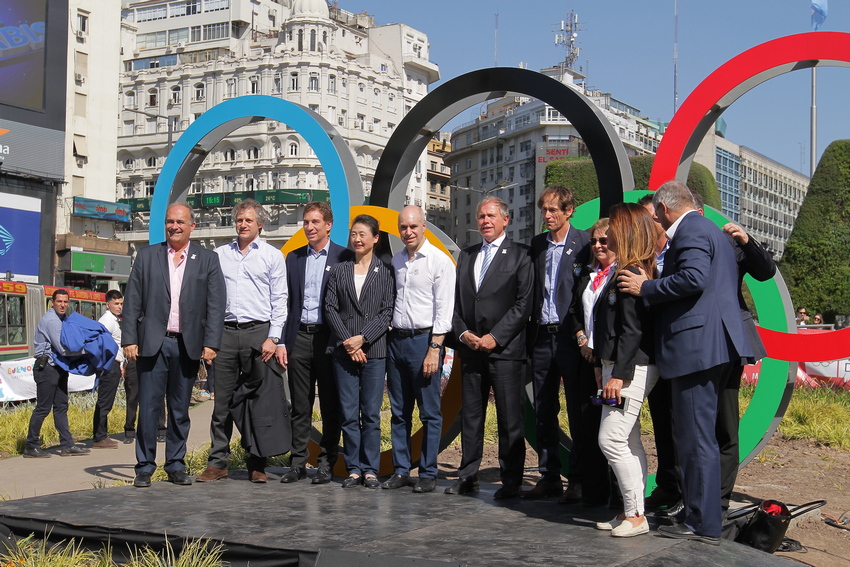 “This proyect for Argentina is something we have been waiting for over 50 years, for the Games to be in our country”, stated Werthein during the ceremony, that counted with the presence of the Rio 2016 gold medal winners Santiago Lange and Pedro Ibarra. “This will be very organized, sustainable, without white elephants Olympic Games. Each venue that has been built has an owner and a porpuse. That will be the legacy”, he added. On behalf of the IOC, Lingwei, one of the best badminton players in history, underscored that “in 365 days Buenos Aires will be ready to open its doors to the world and showcase the very best of Argentina. Athletes and sports fans will experience not only fantastic competitions but a festival of sport and culture spread across four parks throughout Buenos Aires.” “It has been a journey by young people and for young people. A big thank you goes to the tremendous efforts of the talented organising committee who have reached every corner of the city with the many projects to bring sport to the people of Buenos Aires,” she added.
Buenos Aires 2018 will also feature for the first time in history the same number of male and female athletes. The 3998 athletes that will compete in 241 events are also to take part in educational and cultural activities during the Games. At the same time, spectators will be able to enjoy the competitions as well as a comprehensive events and celebrations program that will include introduction to sports activities, following the idea of knowing the transformative power of the Olympic values.
Buenos Aires 2018 will also mark the first time in history in which there will be the same amount of athletes men than women. The 3,998 athletes who will compete in 241 events will also participate in educational and cultural activities throughout the Games.
Page 77 of 146