New dates for Tokyo 2020 confirmed for 2021. The Summer Games will be celebrated from 23 July
The International Olympic Committee (IOC), the International Paralympic Committee (IPC), the Tokyo 2020 Organising Committee, the Tokyo Metropolitan Government and the Government of Japan today agreed new dates for the Games of the XXXII Olympiad, in 2021. The Olympic Games Tokyo 2020 will be celebrated from 23 July to 8 August 2021. They also agreed on new dates for the Paralympic Games, which will be celebrated from 24 August until 5 September 2021.
The leaderships of the key parties came together via telephone conference earlier today, joined by IOC President Thomas Bach, Tokyo 2020 President Mori Yoshirō, Tokyo Governor Koike Yuriko and Olympic and Paralympic Minister Hashimoto Seiko, and agreed on the new schedule.
This decision was taken based on three main considerations and in line with the principles established by the IOC Executive Board (EB) on 17 March 2020 and confirmed at its meeting today. These were supported by all the International Summer Olympic Sports Federations (IFs) and all the National Olympic Committees (NOCs):
1. To protect the health of the athletes and everyone involved, and to support the containment of the COVID-19 virus.
2. To safeguard the interests of the athletes and of Olympic sport.
3. The global international sports calendar.
These new dates give the health authorities and all involved in the organisation of the Games the maximum time to deal with the constantly changing landscape and the disruption caused by the COVID-19 pandemic. The new dates, exactly one year after those originally planned for 2020 (Olympic Games: 24 July to 9 August 2020 and Paralympic Games: 25 August to 6 September 2020), also have the added benefit that any disruption that the postponement will cause to the international sports calendar can be kept to a minimum, in the interests of the athletes and the IFs. Additionally, they will provide sufficient time to finish the qualification process. The same heat mitigation measures as planned for 2020 will be implemented.
In a call on Tuesday 24 March 2020, based on information provided by the WHO at the time, IOC President Thomas Bach and Japanese Prime Minister Abe Shinzō concluded that the Olympic Games Tokyo 2020 would be held in their complete form and not later than summer 2021. The Prime Minister reiterated that the government of Japan stands ready to fulfil its responsibility for hosting these successful Games. At the same time, IOC President Thomas Bach stressed the full commitment of the IOC to successful Olympic Games Tokyo 2020.
Following today’s decision, the IOC President said: “I want to thank the International Federations for their unanimous support and the Continental Associations of National Olympic Committees for the great partnership and their support in the consultation process over the last few days. I would also like to thank the IOC Athletes’ Commission, with whom we have been in constant contact. With this announcement, I am confident that, working together with the Tokyo 2020 Organising Committee, the Tokyo Metropolitan Government, the Japanese Government and all our stakeholders, we can master this unprecedented challenge. Humankind currently finds itself in a dark tunnel. These Olympic Games Tokyo 2020 can be a light at the end of this tunnel.”
Andrew Parsons, the President of the IPC, commented: “It is fantastic news that we could find new dates so quickly for the Tokyo 2020 Games. The new dates provide certainty for the athletes, reassurance for the stakeholders and something to look forward to for the whole world. When the Paralympic Games do take place in Tokyo next year, they will be an extra-special display of humanity uniting as one, a global celebration of human resilience and a sensational showcase of sport. With the Tokyo 2020 Paralympic Games 512 days away, the priority for all those involved in the Paralympic Movement must be to focus on staying safe with their friends and family during this unprecedented and difficult time.”
The President of the Tokyo 2020 Organising Committee, Mori Yoshirō, said: “IOC President Thomas Bach and the Tokyo 2020 Organising Committee held a conference call today to discuss in detail the revised dates of the Tokyo 2020 Games. Minister for the Tokyo Olympic and Paralympic Games Hashimoto Seiko and Tokyo Governor Koike Yuriko joined the call. I proposed that the Games should be hosted between July and August 2021, and I really appreciate that President Bach, having discussed this proposal with the various international sports federations and other related organisations, kindly accepted my proposal. A certain amount of time is required for the selection and qualification of athletes and for their training and preparation, and the consensus was that staging the rescheduled Games during the summer vacation in Japan would be preferable. In terms of transport, arranging volunteers and the provision of tickets for those in Japan and overseas, as well as allowing for the COVID-19 situation, we think that it would be better to reschedule the Games to one year later than planned, in the summer of 2021. Notwithstanding the postponement of the Olympic and Paralympic Games for the first time in history, and various other issues that have already been highlighted, the event schedule is the cornerstone of future preparations, and I am convinced that taking this decision promptly will help speed up future preparations. I would like to thank all the stakeholders, including the host city Tokyo and the Government of Japan, for their hard work during this short period. The Tokyo 2020 Organising Committee will continue to work hard for the success of next year's Games.”
Governor Koike Yuriko said: “In consideration of the global coronavirus outbreak, we need a certain timeframe before we fully prepare for the delivery of Games that are safe and secure for the athletes and spectators. Also, the preparation for the new dates will go smoothly, as the dates match with same timeframe as the original competition dates, corresponding with ticketing, venue staffing, volunteers and transport. Therefore, I believe that celebrating the opening of the Olympic Games Tokyo 2020 on 23 July 2021 is ideal. The athletes, volunteers, torchbearers and local municipality governments have been concerned about the situation. Since we now have concrete new dates to aim for, the Tokyo Metropolitan Government will commit all its resources, and work closely with the Tokyo 2020 Organising Committee, the national government and other stakeholders to fully prepare for the delivery of Games that are safe and secure.”
It has previously been confirmed that all athletes already qualified and quota places already assigned for the Olympic Games Tokyo 2020 will remain unchanged. This is a result of the fact that these Olympic Games Tokyo , in agreement with Japan, will remain the Games of the XXXII Olympiad.
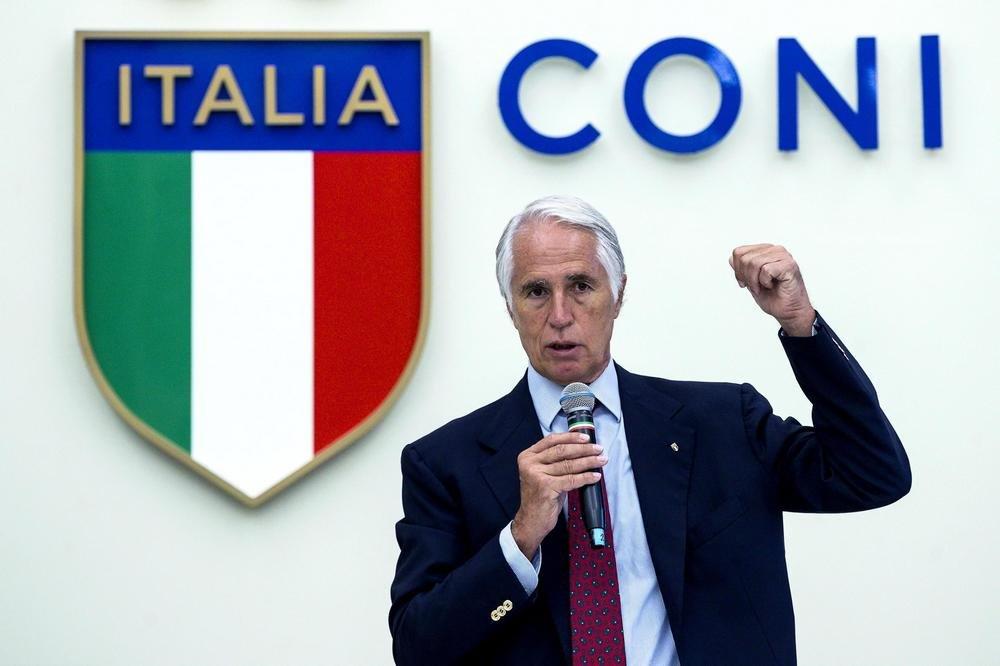
Statement of President Malagò on the postponement of the Tokyo Olympics
- CONI
President of CONI, Giovanni Malagò, issued the following statements on the postponement of the Tokyo Olympics until 2021.

Toyota launches “The Unbreakable” campaign
- TOWARDS TOKYO 2020
In 2017, Toyota launched the global communication campaign 'Start Your Impossible' as a testament to its commitment to creating an inclusive society in which all discrimination and barriers are eliminated, and in which all individuals can move freely without restriction - autonomy of movement is one of the noblest expressions of freedom. With this goal in mind and at the end of the same year, Toyota announced its global partnership with the Olympic Committee and the International Paralympic Committee: through the values of sport, Toyota wants to promote a society in which every individual can face every challenge and overcome their own limits through willpower (that of athletes) and ingenuity, which provides increasingly advanced and environmentally-friendly mobility solutions.
It was the beginning of a long journey that, in Italy, saw the birth of a close collaboration between Toyota Motor Italia and CONI and CIP. A significant step was the creation of the Toyota Team, a group that includes prestigious athletes such as Beatrice 'Bebe' Vio, Paralympic fencing champion, Ivan Zaytsev, captain of the National Volleyball Team, Simona Quadarella and Gabriele Detti, both swimming champions, Ivan Federico, skating champion, Andrea Pusateri, Paralympic cycling champion, Ilaria Naef, WCMX champion, Arianna Fontana, Olympic short track champion, and finally Vanessa Ferrari, world champion of artistic gymnastics. Today Toyota launches ‘’, a new chapter in the global 'Start Your Impossible' campaign. These are extraordinary people who have courageously overcome a difficult challenge, physical or emotional, to become even stronger than before. With them, Toyota wishes to celebrate those who have the courage to “challenge the impossible” and who, in the face of failure or adversity, are able to be reborn stronger than before and, consequently, are a source of inspiration for anyone who comes across obstacles along the way: nothing is impossible if we really believe!
It is their scars that make these people unique: in the few months that separate us from the opening ceremony of the Tokyo Olympics, Toyota Motor Italia will tell - in the first part of the campaign - the fantastic stories of 7 athletes of the Toyota Team, with a series of digital films, through the metaphor of Kintsugi - the ancient Japanese restoration technique that consists in repairing fragments of a broken object with gold, enhancing its fractures to make it even more valuable.
Each of them reveals how they have managed to overcome the most difficult moment of their lives, not only those related to sports. At the end of the story they will receive the symbol of the spirit of an Unbreakable, a drop-shaped sculpture, the Doroppu, made by Kintsugi teacher Chiara Lorenzetti.
But also 'Unbreakable' are all those who have gone beyond their limits and the rules of society to make the freedom to move a right for all. Toyota has chosen 7 people - the new Unbreakables - to tell their impossible stories: Alessia Guarnaccia, architect and inventor of the ecoplasbrick; Mattia Barbarossa, the world's youngest founder of an aerospace company; Giovanni Zappatore, inventor of the first 3D printed bionic limb; Marco Dolfin, Paralympic swimmer and orthopaedic surgeon; Daniele Regolo, founder of the first recruiting platform for people with disabilities; Silvia Bonomi, breeder of Sopravissana sheep; and Sofia Corradi, creator of the Erasmus programme.
The new Unbreakables will be the key members, together with the athletes of the Toyota Team, of a ‘digital contest’ live on a dedicated site, www.the-unbreakable.it. Users will be able to vote for their favourite “impossible” story until 31st March, for the one they consider the most moving. By participating in the final draw, they stand the chance to win a trip for two people to Tokyo during the Olympics.
Milano Cortina 2026 Foundation, first informal Executive Board meeting
- WINTER OLYMPIC AND PARALYMPIC GAMES
The first informal Milan Cortina 2026 Executive Board meeting was held this afternoon in Milan, in the Lombardy Regional Council building.
The proceedings were opened with a report by Chairman Giovanni Malagò who briefly outlined all the milestones which led Italy to acquiring the organisation of the 2026 Winter Olympic and Paralympic Games.
Then, CEO Vincenzo Novari took the floor to illustrate his vision of the project and the innovative approach that he would like to give to the organisational structure.
The first EB meeting will be held in Milan on Monday, 24 February, beginning at 12:30 p.m.
The Mediterranean Beach Games return to Italy, Pesaro chosen as host for 2023
The city of Pesaro will host the 2023 Mediterranean Beach Games.
The decision was made official by the International Committee of the Mediterranean Games at the end of the electronic consultation, which began on 27th January and closed on 9th February.
Pesaro has been chosen as the host city of the third edition of the Games with a unanimous decision by the members of the National Olympic Committees of the ICMG, the International Committee of the Mediterranean Games, and the IOC members of the Mediterranean countries.
The President of the ICMG, Amar Addadi, upon announcing the result to the Mayor of Pesaro, Matteo Ricci, said: “I take this opportunity to congratulate both the city of Pesaro and you personally for this election and welcome you to the Mediterranean family. We are convinced that the third edition of the Mediterranean Beach Games will be a great success in the wake of the examples of Pescara 2015 and Patras 2019”.
According to the candidature dossier, the Mediterranean Beach Games in Pesaro will take place from 16th to 23rd September 2023 and will involve 11 sport disciplines.
Soon President Addadi, with an ICMG delegation, will travel to the Marche city to meet the local authorities and representatives of CONI, who have worked with the Municipality within the project, to sign the Host City Contract and hand over the ICMG flag.
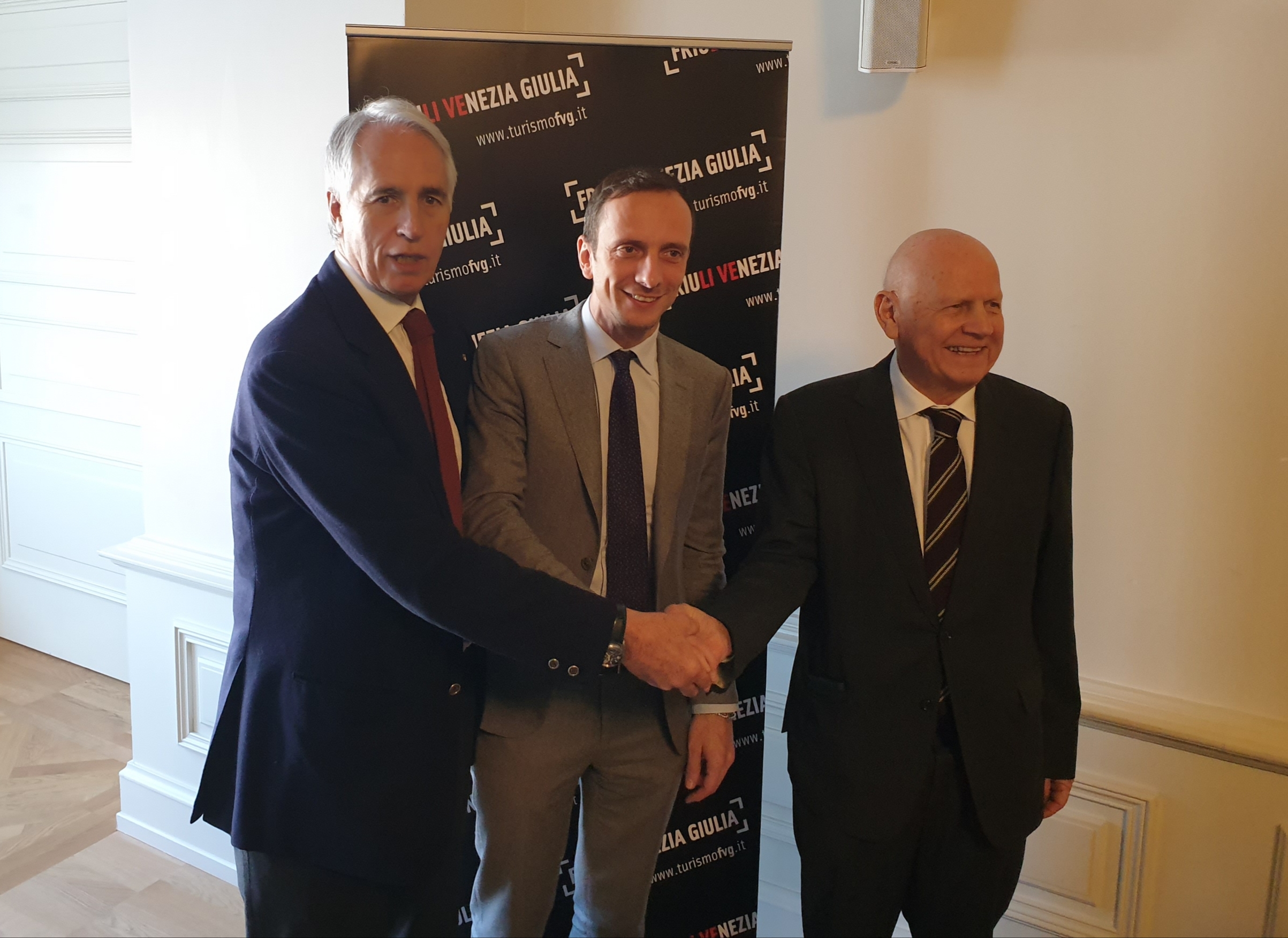
Friuli Venezia Giulia says 'I do' to EYOF 2023
- WINTER EDITION
Friuli Venezia Giulia will host the 16th winter edition of the multi-sport event for elite young athletes aged 14 to 18.
The official agreement was signed by EOC President Janez Kocijančič, President of the Italian National Olympic Committee (CONI) Giovanni Malagò, President of the Friuli Venezia Giulia region Massimiliano Fedriga and President of the EYOF FVG 2023 Organising Committee Maurizio Dünnhofer.
The signing follows the official announcement of Friuli Venezia Giulia as the host of the Winter EYOF 2023 at the 47th EOC General Assembly in Marbella, Spain in November 2018.
Competitions will take place from 21 to 28 January 2023 in 12 sports: alpine skiing, biathlon, cross-country skiing, figure skating, ice hockey, nordic combined, short track, ski jumping, snowboarding, curling, freestyle skiing, and ski mountaineering.
The Opening Ceremony will be held on 21 January in Trieste, while the Closing Ceremony is scheduled for 28 January in Udine.
OP-Ed by Dick Pound on Rule 50
- IOC
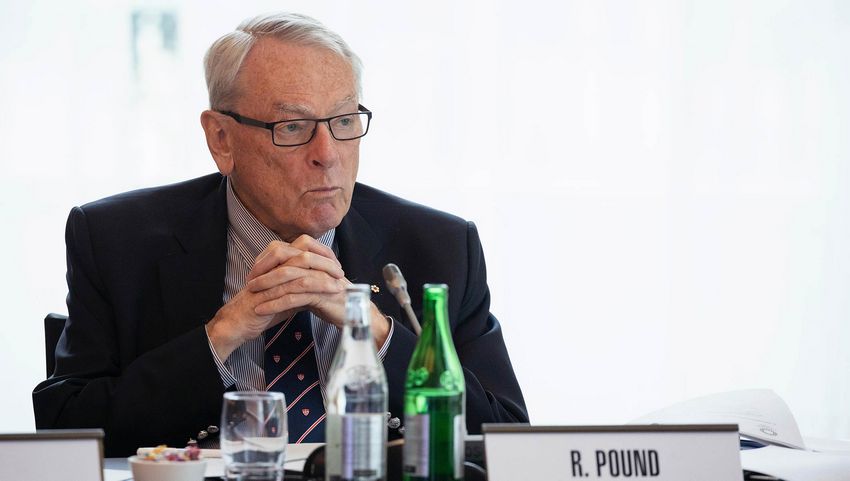
"Free Speech for Olympic Athletes" by Richard W. Pound, IOC Member & IOC Doyen
When critics apply their denouncements with a palette knife or fling them on canvas like Jackson Pollock, intellectual rigour is often lost in the swirl and splash. Similarly, when the operational matrix is “ready – fire – aim”, insufficient attention gets paid to context. In the compulsion to shoot, accuracy is sacrificed.
Take the International Olympic Committee (IOC)’s Rule 50 for example. It provides that no kind of demonstration or political, religious or racial propaganda is permitted in any Olympic sites, venues or other areas. A subset of this rule applies to medal presentations and prohibits demonstrations on the podium. There is a perfectly simple explanation for such a rule, but in some quarters it has been harshly criticised as an unjustifiable incursion into the rights of free speech enjoyed by Olympic athletes.
Let’s set a few facts in order.
The Olympic Games are an international event, now involving some 206 National Olympic Committees (and, by extension, governments), approximately 40 international sports federations and, for Summer Games, about 11,000 athletes. There are a lot of moving parts, not to mention additional factors such as media, spectators and organisational officials.
There are many different and complex international tensions among the 206 countries whose athletes will participate.
The Olympic Games are, however, a special phenomenon during which, even if the world as a whole is not working well, there is an oasis at which the youth of the world can gather for peaceful competition, free from the tensions which their elders have created and with which they will be required to cope before and after the Games. Of course, the Games “bubble” will not last, but each time the Olympic Games are celebrated, a small step is taken – if the Games can work, even if only for 17 days, perhaps, some day, so might the world.
Can anyone in today’s world provide a better example of international peace and goodwill on such a scale? With a reach and emotional bonding measured in billions of people?
Now, back to Rule 50 and the misguided furore surrounding it.
First, this is not a new rule and, second, it is one wholly consistent with the underlying context of the Olympic Games, during which politics, religion, race and sexual orientation are set aside. The guidelines causing the furore were produced by athletes themselves, after extensive consultations. It is athletes who bear the risk of losing the moment they have trained for their whole lives by a protest on the podium.
Everyone has the right to political opinion and the freedom to express such opinions. The IOC fully agrees with that principle and has made it absolutely clear that athletes remain free to express their opinions in press conferences, in media interviews and on social media. But, in a free society, rights may come with certain limitations. Rule 50 restricts the occasions and places for the exercise of such rights. It does not impinge on the rights themselves. Many other governmental and sporting organisations have similar rules restricting demonstrations. Remember, too, that allowing protests on the podium means accepting all protests, not just those with which you may agree.
As is the case with countries, no organisation is perfect. Some, however, including the IOC, are committed to principles and aspirational goals. The IOC is committed to using sport to bring people together in peaceful circumstances, to using it as part of their overall development and to helping expose them to others from around the world. The Games can demonstrate to the world that all things are, indeed, possible, if there is a will to make them happen, tempered by goodwill and mutual respect.
Rule 50 is a reminder that, at the Olympic Games, restraint is an element of that mutual respect. It is entirely appropriate for the IOC, which created the Games, to establish rules that are consistent with the fundamental underlying principles. It is not hubris, as some critics have claimed, but rather a conviction that a better world is possible with a balance of rights and concomitant responsibilities.
It is our lot to be living in a highly differentiated world. It is our duty to bring about change, to create consensus on living together in a manner that respects, not condemns, diversity, and that accepts the right to be different, understanding that there is no perfect ideology or a one-size-fits-all paradigm. The human equation is too broad for such an ersatz solution.
The Olympic Games are, in themselves, no panacea for all of the challenges that face us. But the principles that give rise to the Games can illuminate a way forward that integrates fundamental humanistic values. Avoiding vengeance, especially misguided vengeance, is an admirable beginning.
Rule 50 of the Olympic Charter codifies that important principle. We all need to be reminded of what we have inherited and, without sacrificing any right to freedom of speech, embrace the special experience of the Olympic Games as a building block for a better future.
Richard W. Pound (photo IOC/Greg Martin) is an Olympic finalist in swimming for Team Canada at the Olympic Games Rome 1960 and a lawyer by profession. First President of the World Anti-Doping Agency (WADA) from 1999 to 2007, Pound is the IOC's longest-serving member, having joined the organisation in 1978.
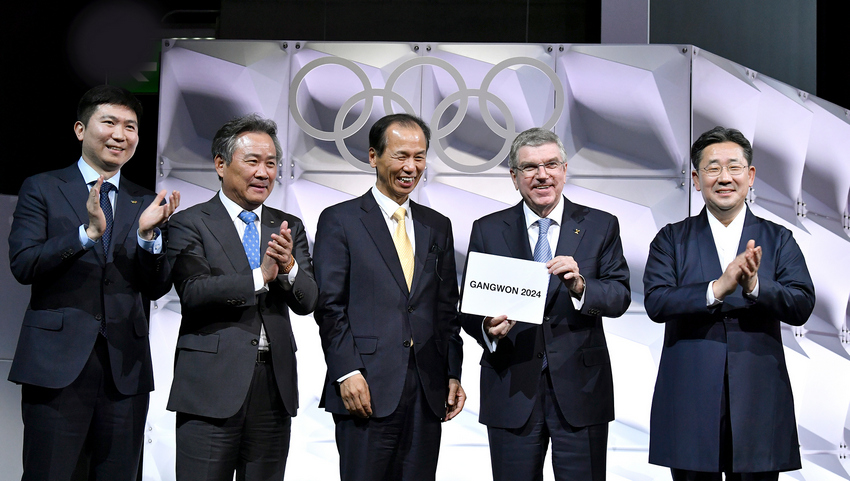
Gangwon 2024: legacy of PyeongChang 2018 lives on in first Winter YOG awarded to Asia
- FOURTH EDITION
The fourth edition of the Winter Youth Olympic Games 2024 will be held in gangwon province in the cities of PyeongChang and Gangneung (Republic of Korea), home to the Olympic Winter Games 2018.
Today in Lausanne (photo IOC), Switzerland, the International Olympic Committee (IOC) Session voted to award the Winter YOG to Asia for the first time, building on the legacy of the Olympic Winter Games PyeongChang 2018.
Gangwon 2024 draws upon the successful delivery of the Olympic Winter Games PyeongChang 2018 and aims to continue their vision of bringing sport to a new generation of winter athletes. The hosting of the Winter YOG leverages the significant investment that the Republic of Korea has made into developing winter sport in the country and throughout Asia.
“Consistent with the Olympic Agenda 2020 reforms, the proposed plans by Gangwon 2024 will ensure the Youth Olympic Games remain sustainable and affordable. The Gangwon 2024 proposition enhances the legacy of PyeongChang 2018,” said IOC President Thomas Bach. “The interest shown by many regions around the world in hosting future Olympic and Youth Olympic Games demonstrates that our new approach, based on constant dialogue, flexibility, sustainability, legacy and creating a project together, is the right approach.”
“The Korean government is committed to providing the necessary support to ensure that the Gangwon 2024 Youth Olympic Games are a great success,” added Park Yang-woo, Minister of Culture, Sport and Tourism and head of the Gangwon 2024 delegation. “We will continue the strong legacy of the recent Olympic Winter Games in PyeongChang and work to achieve our vision of expanding new horizons in sport.”
The new Winter Youth Olympic Games host will benefit from many of the facilities used in PyeongChang 2018 as well as possible alternative venue options. Competitions would take place in PyeongChang (mountain sports) and Gangneung (ice sports), similar to the Games concept in 2018. The Winter YOG will provide young athletes with the opportunity to compete in some of the same venues where Olympians competed a few years earlier. The Youth Olympic Village would be located at student accommodation facilities at Gangneung-Wonju University.
The master plan will be finalised during a co-creation period, in which the IOC and Olympic stakeholders will collaborate with the elected host. The sports programme and a detailed budget aligned to the strategic objectives and local context will also be developed during this period.
The PyeongChang 2018 Legacy Foundation was launched last year to ensure the legacy of the Olympic Winter Games PyeongChang 2018 would continue to benefit the region for decades to come. The foundation aims to continue the development of winter sport in Asia, spread the Olympic values to young people through various sports and education projects, and also manage several venues that were used at the Olympic Winter Games. This year, the Foundation will oversee Olympic values education camps for 20,000 students around the country and also host the annual Dream Programme, now in its 16th year, by providing winter sports training camps to young people from around the world.
From the very beginning of the dialogue, the IOC has indicated to the Korean Sport and Olympic Committee that it would be ready to accept the Olympic Committee of the Democratic People’s Republic of Korea as a partner in the organisation of the 4th Winter Youth Olympic Games, if the circumstances allow.
The awarding of the 4th Winter YOG was the first under the IOC’s new approach to future host elections, part of Olympic Agenda 2020. More targeted and streamlined, it allows greater flexibility and dialogue, in which interest in future Olympic and Youth Olympic Games is overseen by two permanent Future Host Commissions (Summer and Winter). The Commissions advise the IOC Executive Board, which in turn makes recommendations to the IOC Session, including putting forward preferred hosts for election.
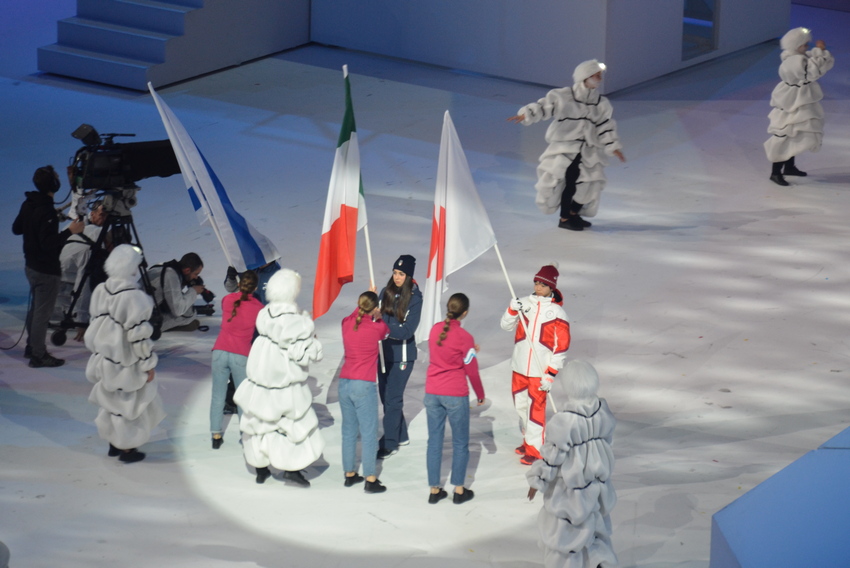
The curtain raises on Lausanne 2020, Alessia Tornaghi parades with Tricolore flag in front of Malagò
- WINTER YOG
The third edition of the Winter Youth Olympic Games officially kicked off with the ceremony tonight at the Vaudoise Aréna.
The capital of the Olympic movement and home of the IOC will host, until 22nd January, the most important under-18 sporting event that will see around 1800 athletes from 79 countries throughout the world compete in 16 disciplines (the Italian athletes, however, will not compete in the skeleton).
Italy made its entrance in the athletes' parade, after Austria and ahead of Slovenia. More than half of the 67 Italian athletes were present on the ice (44 FISI members, 23 FISG members); 33 men and 34 women, who, in total (the rest of the group will arrive on 16th January), will take part in the Olympic event that starts tonight in Switzerland (crossing the French mountains of Les Tuffes). Then, at 8pm on the dot, the show kicked off with a moving display on ice and snow that combined Swiss tradition and innovation.
Present in the stands were the Olympic family and the heads of world sport, with the President of the IOC, Thomas Bach, sitting next to Simonetta Sommaruga, President of the Swiss Confederation who declared the Games open. With them were leaders of Italian sport, including the President of CONI and IOC member, Giovanni Malagò, and the Secretary General and Head of Olympic Preparation, Carlo Mornati, who witnessed the entrance of standard-bearer Alessia Tornaghi, the sixteen-year-old Milanese skater, twice senior Italian champion, who made her entrance at 8.09pm, together with Israel and Japan.
Lausanne is host to one of the two Olympic Villages (on the city's university campus) and three of the scheduled disciplines (Hockey, Figure Skating and Short Track Speed Skating). In the other village of St. Moritz, it was lugeist Alex Gufler who bore the flag at the other scheduled opening ceremony.
Tomorrow, on the snows of the Vaud Alps - in Les Diablerets and Villars - the first Olympic medals for the new entry Ski Mountaineering, which will make its debut in an Olympic event tomorrow with the men's and women's Individual Trial and Alpine Skiing, will already be awarded tomorrow with the men's and women's Super G.
The Lausanne 2020 Games are the first Winter Youth Olympic Games which guarantees an equal number of girls and boys competing for a medal (for the Summer Youth Games this had already happened in Buenos Aires 2018, while for the ‘big’ Games, this will happen for the first time in Tokyo 2020). For the first time, an edition of the Winter Games also includes mixed nationality 3×3 ice hockey, a women's doubles tobogganing competition, and the Nordic Women's Combined. These confirm the YOG as a true laboratory of ideas, driven by the energies of young people and at the service of sport.
Mediterranean Beach Games, Pesaro officially sworn-in for 2023
- THIRD EDITION
ICGM The International Committee of Mediterranean Games has formalised the induction of Pesaro in view of the third edition of the Mediterranean Beach Games, scheduled for 2023. The formalisation of the application, which will be followed by information on the procedure to be carried out for the designation of host cities, came to an end on 31st December.
CONI and the Municipality of Pesaro, which have worked in synergy on the MBG 2023 project, express their pride for the significant recognition, which certifies the depth and value of the candidacy and confirms the undoubted credibility of the sports system and the country at an international level. The ICGM’s confidence represents a solid basis for highlighting the city’s organisational qualities, relying on the expertise of the entire sports movement. Italy previously hosted the first edition of the event in Pescara.
Page 53 of 134