

Curtain falls on Milano Cortina 2026: the Tricolour paraded at the Arena di Verona in the hands of Vittozzi and Ghiotto
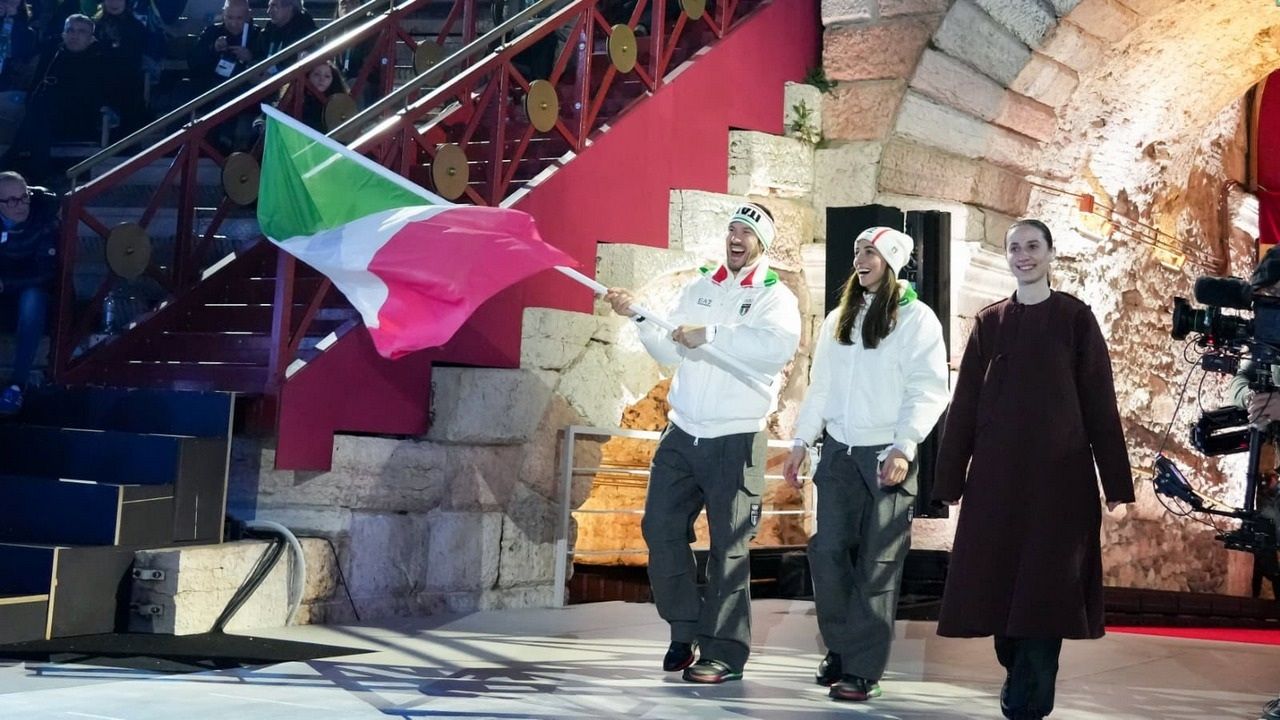
A tribute to beauty to celebrate the conclusion of the Olympics of firsts: with the Closing Ceremony at the Arena di Verona, the curtain officially fell on the Milano Cortina 2026 Winter Olympic Games. The Tricolour was carried by flagbearers Lisa Vittozzi – the first Olympic champion in the history of Italian biathlon thanks to gold in the women’s pursuit in Anterselva, as well as silver medallist alongside Dorothea Wierer, Tommaso Giacomel and Lukas Hofer in the mixed relay – and Davide Ghiotto, triumphant in the speed skating team pursuit with Andrea Giovannini and Michele Malfatti.
“It was a unique and indescribable emotion, especially because of the enthusiasm conveyed by the crowd. Truly a special moment,” declared Ghiotto. “We experienced something deeply moving. We are proud to have represented our country in the Ceremony that closed the most successful Winter Olympics ever for the Italia Team,” said Vittozzi.
The Italian delegation (photo Simone Ferraro/CONI) took part in the closing parade under the gaze of Prime Minister Giorgia Meloni, IOC President Kirsty Coventry, CONI President Luciano Buonfiglio and CONI Vice President Diana Bianchedi. Also present were Senate President Ignazio La Russa, Chamber President Lorenzo Fontana, Minister for Sport and Youth Andrea Abodi, President of the Milano Cortina 2026 Foundation Giovanni Malagò, as well as representatives of the local authorities involved. Among them were the Mayor of Milan, Giuseppe Sala, and the Mayor of Cortina d’Ampezzo, Gianluca Lorenzi, who handed over to Alpes Françaises 2030, the next Winter edition, represented by the President of the Provence-Alpes-Côte d’Azur Region, Renaud Muselier, and the President of the Auvergne-Rhône-Alpes Region, Fabrice Pannekoucke. It served as a prelude to the extinguishing of the Cauldrons at the Arco della Pace in Milan and in Piazza Angelo Dibona in Cortina.
Thus concludes the Olympics of records and firsts for the Italia Team. Thirty medals in total, including 10 gold, alongside six silver and 14 bronze. Figures surpassing those of Lillehammer 1994, the Winter Games edition which for 32 years had held the Italian record for podium finishes (20) and gold medals (seven). With the largest Italian Winter delegation ever (196 athletes, 103 men and 93 women), the Italia Team won medals in 10 different disciplines (alpine skiing, biathlon, cross-country skiing, curling, figure skating, freestyle, luge, short track, snowboard and speed skating), one fewer than the historical record set by the United States at PyeongChang 2018. All four flagbearers – the first Olympics in history with four standard-bearers at the Opening Ceremony – won medals: Federico Pellegrino with bronze in the relay and team sprint; Federica Brignone with gold in the giant slalom and super-G; Amos Mosaner with bronze in mixed doubles curling; Arianna Fontana with gold in the mixed relay and silver in the 500 metres and 3,000m women’s relay. The percentage of medals won at Milano Cortina 2026 relative to the total medals awarded (8.62%) is, in absolute terms, second only to the Summer edition of Los Angeles 1932 (9.72%) and the Winter edition of Lillehammer 1994 (10.92%). Numerous individual records were also set. Arianna Fontana surpassed the all-time Italian Olympic medal record (14), previously held by fencing legend Edoardo Mangiarotti (13). In the all-time Winter standings, the Italian short track star is joint second with former Norwegian biathlete Ole Einar Bjørndalen, behind only former Norwegian cross-country skier Marit Bjørgen (15). Francesca Lollobrigida (gold in the 3,000 and 5,000 metres) is the first Italian woman to win the most prestigious medal in speed skating, as well as the first Italian overall to do so since Enrico Fabris (Turin 2006, gold in the 1,500 metres and team pursuit). Federica Brignone’s historic double gold (giant slalom and super-G) mirrors the feat achieved only by Alberto Tomba in alpine skiing at a single edition of the Games (special slalom and giant slalom, Calgary 1988). Historic too was Lisa Vittozzi’s gold in the women’s 10km pursuit, the first Olympic triumph in the history of Italian biathlon.
Among the highlights was Sofia Goggia’s bronze in the downhill, making her the first woman in history to claim three consecutive Olympic podiums in the discipline after gold at PyeongChang 2018 and silver at Beijing 2022. In the Milano Cortina 2026 medal table there was also Italy’s first team medal in figure skating (bronze in the team event: Sara Conti, Niccolò Macii, Charlène Guignard, Marco Fabbri, Daniel Grassl, Matteo Rizzo and Lara Naki Gutmann), the first Italian gold in the short track mixed relay (Chiara Betti, Elisa Confortola, Arianna Fontana, Thomas Nadalini, Pietro Sighel and Luca Spechenhauser), the first double triumph in luge doubles (Simon Kainzwaldner and Emanuel Rieder in the men’s event; Marion Oberhofer and Andrea Vötter in the women’s), a discipline that also saw the first historic podium (bronze) in the team relay (Dominik Fischnaller, Verena Hofer, together with the aforementioned Kainzwaldner, Rieder, Oberhofer and Vötter). Furthermore, the first Italian freestyle medals (gold for Simone Deromedis and silver for Federico Tomasoni in ski cross, and bronze for Flora Tabanelli in big air) and the first medal in the cross-country skiing team sprint (bronze for Elia Barp and Federico Pellegrino). Not forgetting a participation worth a medal in itself: Roland Fischnaller’s seventh Winter Olympic appearance. None like him. No other Olympics like Milano Cortina 2026. The curtain falls, yet the journey continues and the ambition to improve remains unchanged. The Flame is ready to burn again with two major targets in sight: in two years’ time the Los Angeles 2028 Summer Games, and in four the Winter Olympics in the French Alps. (agc)