


Milano Cortina 2026 enters history, President Luciano Buonfiglio: “An Olympics worthy of top marks"
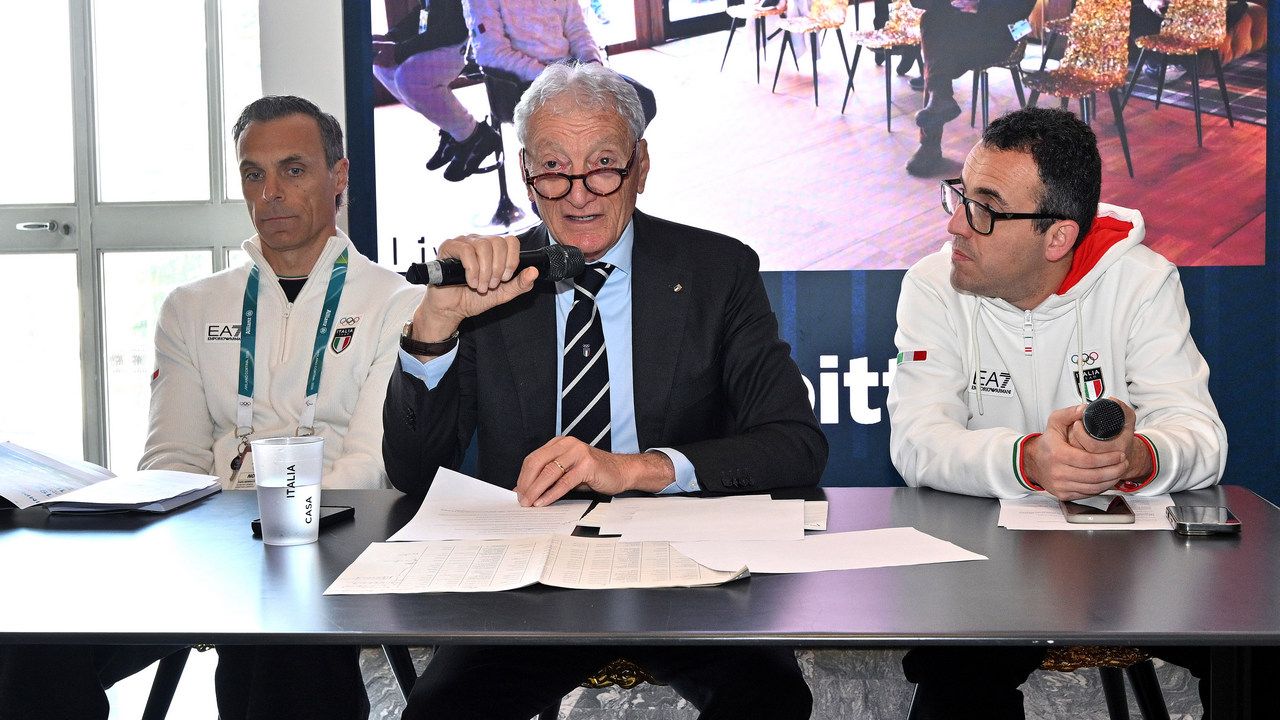
“An Olympics worthy of top marks: 30/30 with honours.” That was how the President of the Italian National Olympic Committee (CONI), Luciano Buonfiglio, summed up the final balance during the closing press conference (photo Ferdinando Mezzelani/CONI) of the Milano Cortina 2026 Winter Games, held at Casa Italia Milano, with live links to the other hospitality houses in Cortina and Livigno. Thirty medals in total, including ten gold: the five-ring event concluded with record-breaking figures, surpassing those of Lillehammer 1994, the Games which for 32 years had held the Italian Winter record for podium finishes (20) and gold medals (seven).
President Buonfiglio opened the press conference by recalling the words on sport in the New Year’s message of the President of the Republic, Sergio Mattarella. “We answered the call with these widespread Games, with 103 men and 93 women, with 10 gold, six silver and 14 bronze medals. With the Milano Cortina Olympics we too have contributed to enriching the history of our Republic,” stated Buonfiglio. “We wish to thank President Mattarella because he has always been present, warm but above all knowledgeable, as he also demonstrated at these Games, where he stood by us on more than one occasion. He attended the Opening Ceremony but was also present at venues where our athletes triumphed. This is an important signal for the entire Italian sporting movement,” added Buonfiglio, who also underlined that the Head of State and the President of the Council of Ministers, Giorgia Meloni, were awarded the Olympic Order in Gold, the highest honour of the IOC, whose Executive Board also bestowed the Olympic Order in Silver upon Deputy Prime Minister and Minister of Infrastructure and Transport Matteo Salvini, Minister for Sport and Youth Andrea Abodi, Minister of Economy and Finance Giancarlo Giorgetti, as well as representatives of local authorities, the Milano Cortina 2026 Foundation and SIMICO.
“I thank the Secretary General and Chef de Mission, Carlo Mornati, and all the staff because we lacked nothing. We were capable of overcoming every difficulty in the first widespread Olympics. It was not easy to guarantee the same level of assistance and support to everyone. Sixteen disciplines formed part of the programme, spread across six different locations. The effort was significant and has helped all of us to improve,” explained Buonfiglio. “These were the Games of firsts. The first time with four flagbearers. And all four won medals: Federico Pellegrino with bronze in the relay and team sprint; Federica Brignone with gold in the giant slalom and super-G; Amos Mosaner with bronze in mixed doubles curling; and Arianna Fontana with gold in the 2,000m mixed relay and silver in the 500 metres and 3,000m women’s relay,” continued the CONI President. “We recorded the absolute record for prize money awarded at a Winter Olympic Games. It is the highest level ever recognised by our Olympic Committee at a Winter Olympics. And we would never have tired of awarding more, because behind a cash prize there is recognition of the athletes’ years of commitment, their ability to remain at the top of their disciplines, their determination to overcome any obstacle, and also their capacity to serve as an example in encouraging young people to take up sport.”
Buonfiglio then recalled several of the historic milestones reached at these Games. “Arianna Fontana reached 14 Olympic medals, becoming the most decorated Italian athlete of all time. Francesca Lollobrigida claimed gold in the 3,000 and 5,000 metres, the first Italian woman ever to win in speed skating. Federica Brignone completed an Olympic double (giant slalom and super-G), as only Alberto Tomba had done in 1988. Hers is a story we experienced with great emotion. Then came the first gold in history in biathlon with Lisa Vittozzi. The first team medal in figure skating and the first Olympic double gold in luge doubles events, along with the first podium in the team relay. The first gold in the short track mixed relay arrived, as did Italy’s first-ever freestyle medals with Flora Tabanelli’s bronze in big air and gold and silver for Simone Deromedis and Federico Tomasoni in ski cross. Furthermore, the first medal in the cross-country skiing team sprint was won by Elia Barp and Federico Pellegrino. The wonderful story of Pietro and Arianna Sighel, brother and sister both medallists in their respective relays. And I do not forget Roland Fischnaller, at his seventh Olympics, an Italian record for Winter Games appearances, an example of longevity and dedication. Moreover, if we combine the results of Paris 2024 and Milano Cortina 2026, we are among the top four nations in the world in terms of medals won,” said Buonfiglio, who also recalled that all the athletes present at the IOC Session in Lausanne in 2019 to support the Italian bid stood on the podium at Milano Cortina 2026 (Arianna Fontana, Elisa Confortola, Sofia Goggia, Michela Moioli).
“The medals arrived within the performance evaluation perimeter identified by Olympic Preparation together with the Secretary General. The medal table represents a system capable of working together,” added CONI President Luciano Buonfiglio. “It is not easy; it means listening to others, bringing together the right elements, without entrenching ourselves behind what we want to push forward at all costs, but advancing it in the best, most effective and efficient way. The affection that these Games generated among Italians is what fills us with the greatest pride; it is a feeling that remains within us. The result is extremely positive. Evidently the phrase ‘We are destined to win’ is bearing fruit.”
Speaking also was CONI Secretary General and Chef de Mission Carlo Mornati, who focused on the three Casa Italia venues in Milan, Cortina and Livigno: “It was a new model for us as well. For the first time all were open to the public. At the Triennale in Milan there was one of the greatest forms of activation for the Olympics, a way for the Olympic Committee to open itself to the citizens. The same can be said for Livigno, at Aquagranda, which became a place of gathering. Casa Italia Cortina was effectively an art gallery, open to the general public. The figures are very encouraging and we believe we have done significant work in promoting many disciplines.” At the end of the press conference a video dedicated to the three Casa Italia venues was shown. More than 6,000 square metres were set up across the hospitality houses, enriched by 504 design objects and 123 works of art by 86 national and international artists, attracting over 120,000 guests. A unique blend of sport, art and culture at the Olympics of records. (agc)