

Dakar 2026 medals unveiled: a story of Senegal from ancient roots to a vision of the future
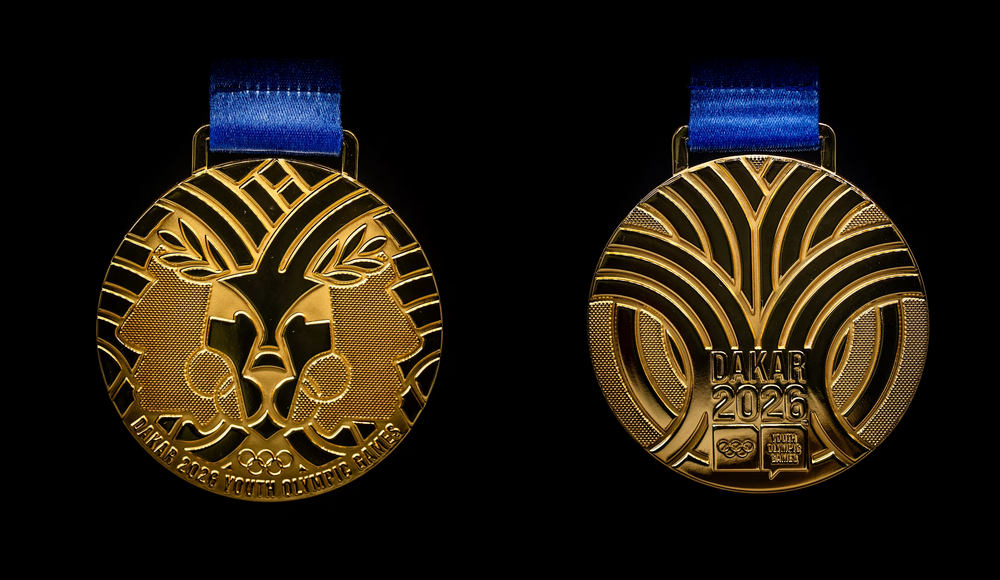
Winning a medal in a competition is probably the ultimate goal for any athlete. It rewards years of hard work, sacrifice and perseverance. For the young champions of the Dakar 2026 Youth Olympic Games, it will also hold special significance. For the first time in history, an Olympic sporting event is being held on the African continent. The medals awarded to the winning athletes at this unprecedented edition have therefore been designed to tell the story of Senegal, its heritage and its youth. On Wednesday 16 September, the medals for the 2026 Dakar Youth Olympic Games were unveiled to the public. On both sides of the medals, several symbols complement one another: the lion and the baobab tree, directly inspired by Senegalese culture, as well as motifs specific to the Olympic movement.
On the obverse of the medal, the lion takes centre stage. An iconic symbol of Senegal, the lion is commonly associated with strength and courage, two essential qualities in sport. Its mane consists of two faces inspired by Senegalese craftsmanship. Arranged symmetrically, they represent fairness, a fundamental principle of sporting competition. Each face is crowned with an olive wreath. In Olympic tradition, this is a symbol of victory, peace and excellence. It is a direct reference to the history of the Olympic Games. This design was developed following a global call for proposals launched by the International Olympic Committee. Named ‘The Roar of Youth’, this striking motif was conceived by the 26-year-old Spanish designer Pilar Barbadillo Vicario.
On the reverse side, another iconic symbol of Senegal appears: the baobab. An emblematic tree of the ‘Land of Teranga’ and, more broadly, of the entire African continent, it evokes strength, longevity, wisdom and the passing on of knowledge. In this context, the baobab also echoes the idea of a youth that is growing and building itself up from its roots. On this side of the medal, the baobab takes on a contemporary graphic style, echoing the original design on the obverse. Its roots and branches unfurl in curves and counter-curves, as if to give the tree a sense of movement and elevation. These lines also evoke cables, alluding to new technologies and connectivity in the digital age. The ancient baobab tree is thus transformed into a connected structure. A dialogue between Senegalese heritage and modernity. To create this design, a competition was organised in partnership with the National School of Arts of Senegal.
The overall motif on both sides of the medals thus conveys a balance between deep roots and forward momentum. Between heritage and the future. The design of the medals also forms part of a broader theme: “From History to the Future”. This theme creates a dialogue between Senegal’s heritage and its ambitions for future generations. It serves as a reminder of the importance of understanding one’s history whilst building the future. This convergence of nature and innovation reflects the very ambition of the Dakar 2026 YOG: to celebrate Senegal’s history and culture whilst looking to the future. The medal thus becomes a symbol of a youth firmly rooted in its heritage, yet ready to make history. The medals for the Dakar 2026 YOG will accompany the young athletes onto the podium as their achievements are celebrated. But they will also carry a piece of the history of the host country and of the continent where humanity first emerged.